Music
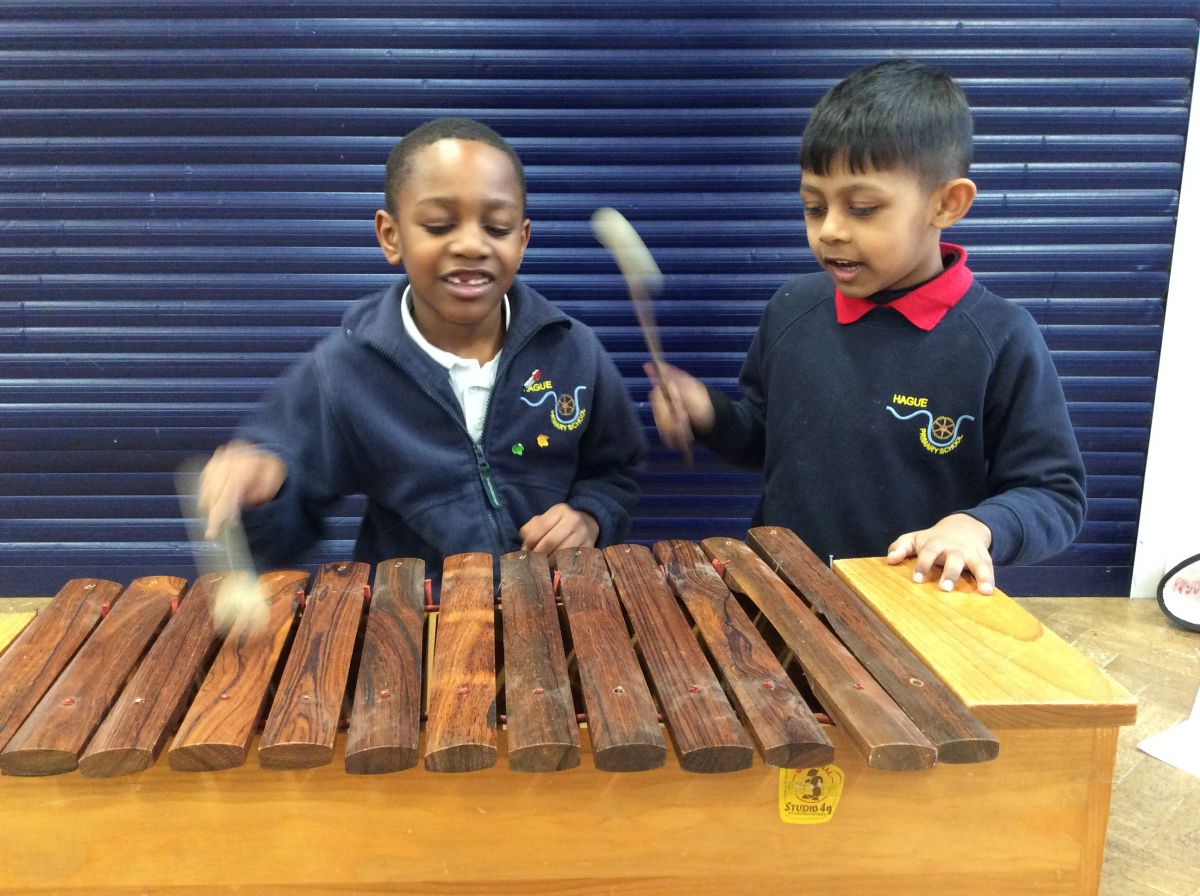
Music Curriculum & Intent Statement
“Nurturing Creativity, Celebrating Diversity, and Harmonising our Community”
Introduction: Our Musical Philosophy
At Stewart Headlam and Hague Primary Schools, music is not treated as an isolated subject or an afterthought; it is a fundamental pillar of our vibrant school culture. We firmly believe that a high-quality music education engages, inspires, and equips pupils with the confidence to find their unique voice.
Singing and performing are deeply embedded and celebrated in our schools. We take both our core music curriculum and our enrichment exceptionally seriously, ensuring that every child is given the keys to musical literacy, creative expression, and technical proficiency.
The Early Years Foundation Stage (EYFS): A Holistic Approach
Our musical journey begins in Nursery and Reception with a deeply holistic approach to the soundscape of early childhood. Rather than rigid structures, our EYFS music framework focuses on immersive, multi-sensory experiences that blend organically into daily learning.
Through standard continuous provision, children explore:
- Communication and Language: Developing phonology, vocabulary, and memory through daily rhymes, chants, and storytelling.
- Physical Development: Developing gross and fine motor skills by responding physically to tempos, playing untuned percussion, and exploring spatial awareness through movement.
- Personal, Social, and Emotional Development: Using song to co-regulate, share, build collaboration, and express emotions in a safe, celebratory environment.
The Key Stage 1 & 2 Progressive Curriculum
From Year 1 through to Year 6, our music curriculum is rigorously sequenced across six core units to ensure children build cumulative knowledge and skills year-on-year:
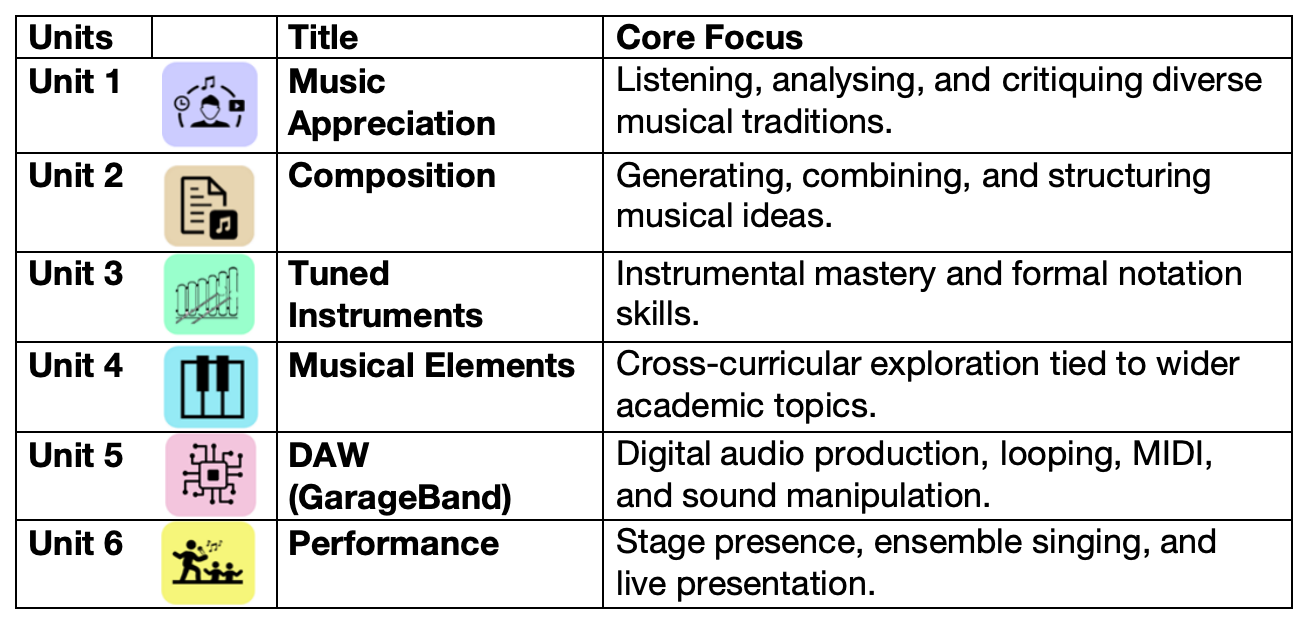
1. Unit 1: Music Appreciation
Children step into the shoes of "Genre Detectives." They listen to, analyse, and critique a culturally diverse and historically rich repertoire of music—spanning classical masters, global icons, and modern pioneers. Pupils master musical vocabulary to express how music tells stories and evokes human emotion.
2. Unit 2: Composition
Children develop their creative voice by structuring their own original music. Through explicit teaching of motif development, arrangement, and harmony, pupils learn how to translate emotions and visual prompts into soundscapes and songs.
Progressive Skill Building (Composition & DAW):
To ensure continuous growth, core skills in both Composition (Unit 2) and DAW (Unit 5) follow a two-year developmental arc across Key Stages. In the first year of a stage, pupils explore the essential foundations and basic tools. In the second year, the tasks become intentionally more challenging—demanding deeper structural reasoning, multi-track layering, and refined editing techniques.
3. Unit 3: Tuned Instruments
To build robust instrumental capability and formal notation skills, children engage in dedicated tuned instrument study. This ensures that every child leaves Key Stage 2 with a strong foundational grip on reading staff notation, tracking pitch changes, and mastering the physical dexterity required to play melodic instruments in an ensemble.
4. Unit 4: Musical Elements (Cross-Curricular Topic Links)
Music does not exist in a vacuum. In this unit, musical concepts—such as pitch, timbre, texture, dynamics, and tempo—are masterfully intertwined with each year group’s termly history, geography, or science topic:
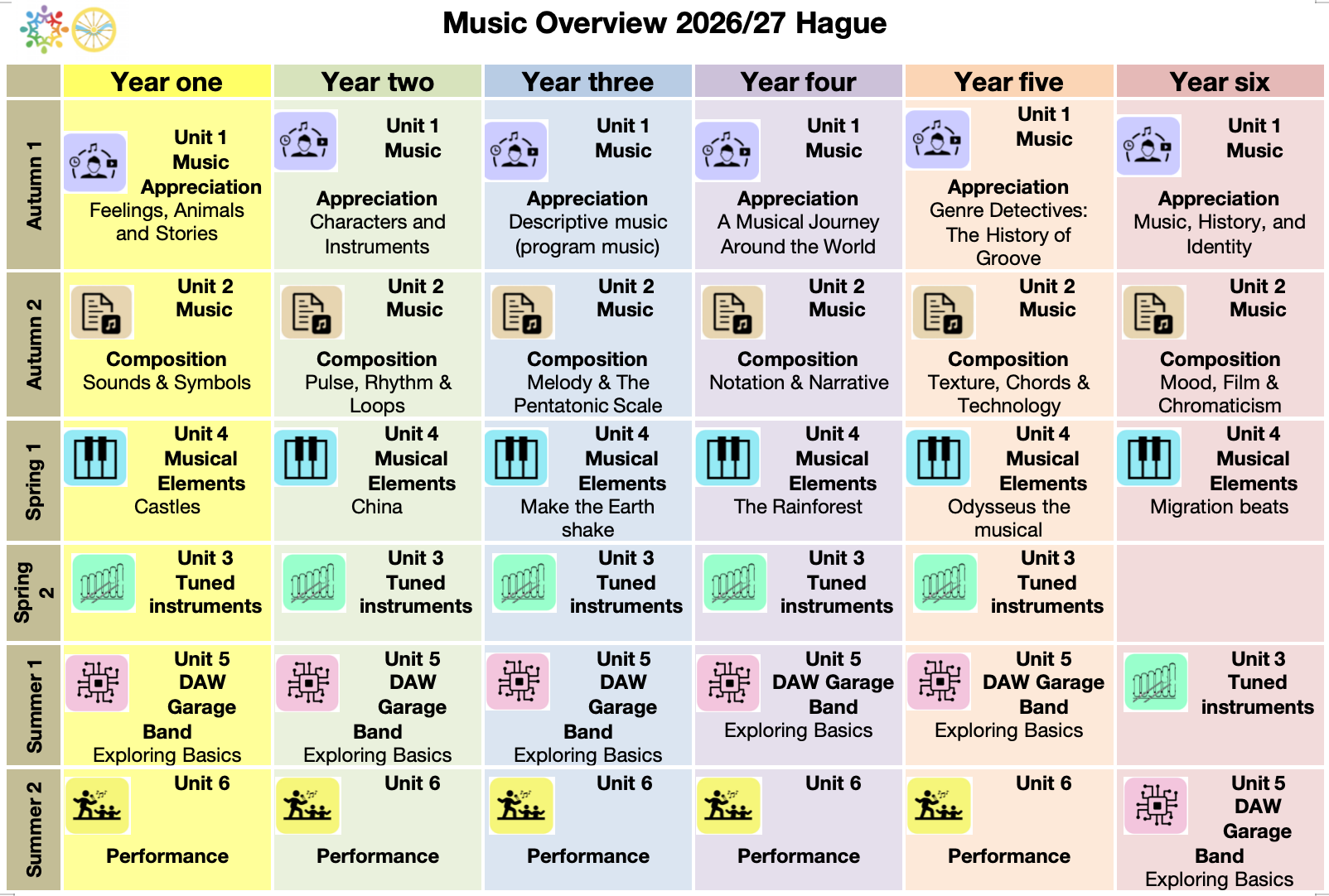
- Year 1: Sounds of the Castle (Exploring timbre and dynamics)
- Year 2: The Mystical Sound of China (Exploring pentatonic structures and traditional timbres)
- Year 3: Make the World Shake! – Volcanoes & Earthquakes (Exploring dramatic dynamics and texture)
- Year 4: Rainforest Layers (Exploring polyrhythms and complex sonic layers)
- Year 5: Odysseus & the Ancient Greeks (Exploring programmatic storytelling and modes)
- Year 6: Migration Beats (Exploring rhythm, movement, and cultural identity)
5. Unit 5: DAW – GarageBand (Music Technology)
Recognising the digital landscape of the 21st century, every year group accesses a specialized digital audio workstation (DAW) unit using GarageBand. Pupils learn to loop, arrange, manipulate MIDI data, multitrack, and mix electronic sounds—bridging traditional music-making with modern technology.
6. Unit 6: Performance
Music is ultimately meant to be shared. The final unit focuses on the grit, rehearsal discipline, and absolute joy of live performance. Children learn to manage stage presence, maintain independent rhythms within an ensemble, and present polished pieces to peers, parents, and the wider community.
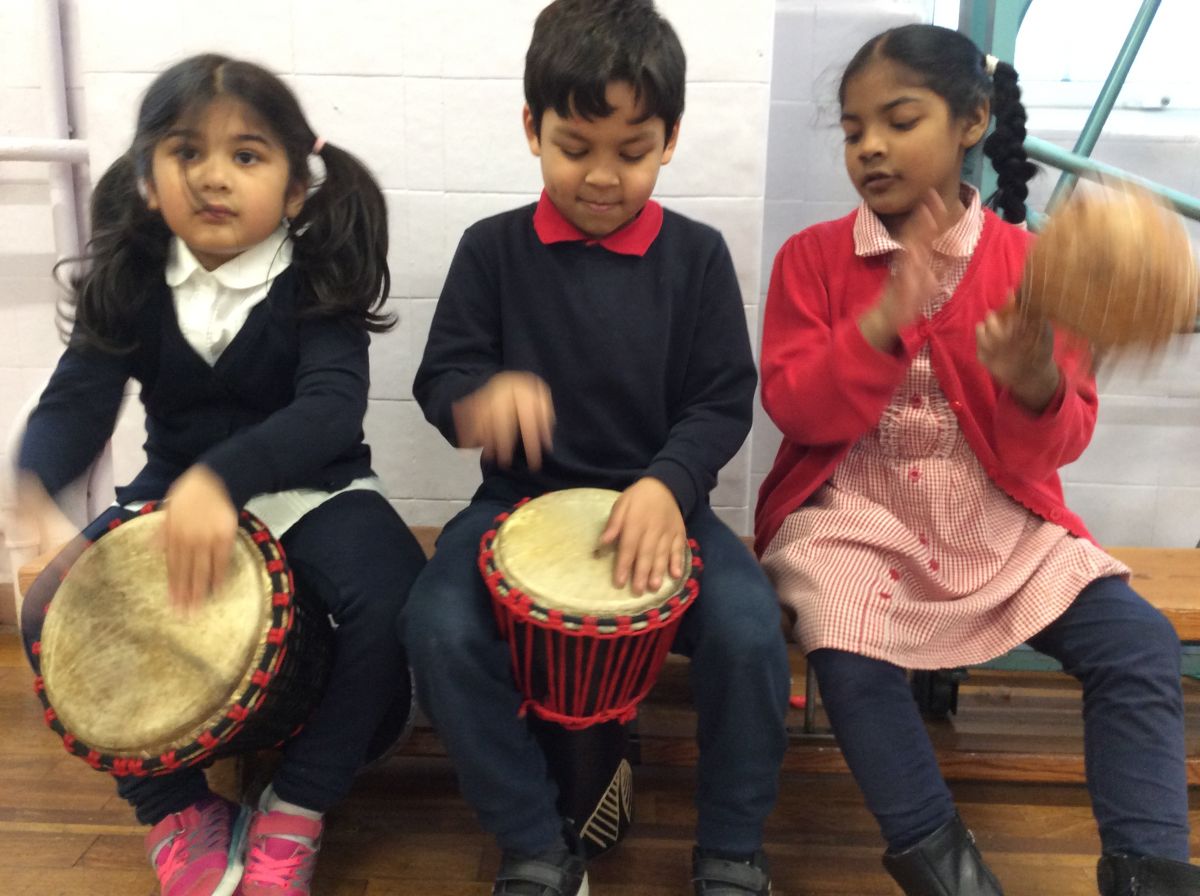 Inclusive Practice: Music for Every Child
At Stewart Headlam and Hague, we firmly believe that music is a universal language and that every child, regardless of background, specific learning needs, or disability, has an absolute right to a rich, empowering music education.
To ensure equitable access across all six curriculum units, we intentionally adapt our music provision by:
- Adaptive Instrumentation & Tools: Utilising accessible tuned and untuned percussion, tactile sound-makers, and adaptive digital interfaces on GarageBand so every pupil can create and perform independently.
- Multi-Sensory Approaches: Blending auditory, visual, and kinaesthetic strategies—such as graphic notation, color-coded instrument keys, and movement-based rhythm games—to accommodate diverse learning styles.
- Scaffolding & Personalised Support: Structuring tasks with step-by-step visual guides, peer buddying, and tailored adult support during performance, composition, and digital production tasks.
- Flexible Participation: Celebrating all forms of musical expression—whether a child contributes through vocalising, playing rhythm, managing digital sound loops, or expressing music through movement—ensuring every pupil experiences the joy of achievement and belonging in our musical community.
Enriched Harmonies: The Weaver’s Federation Choir
Our commitment to musical excellence stretches far beyond the classroom walls. Both Stewart Headlam and Hague Primary Schools proudly run their own flourishing school choirs, nurturing elite vocal talent and a shared love for singing. Every year, our school choirs shine on stage as part of the annual East 1 Partnership Christmas Concerts, celebrating music alongside our local school community.
Looking to the future, we have proudly participated the first year of developing the Weaver’s Federation Choir in collaboration with Swanlea School. As this exciting partnership grows, it will provide our primary pupils with exceptional mentorship opportunities, access to secondary-level expertise, and the grand experience of performing complex, large-scale vocal arrangements.
Tuning into the Future: The Lifelong Impact
We do not just teach music to create professional musicians; we teach music to build well-rounded, resilient, and successful human beings. This highly balanced curriculum equips our children with vital transferable skills essential for their futures:
- Academic & Cognitive Growth: Learning notation, digital sequencing, and rhythm enhances spatial-temporal reasoning, mathematical tracking, and linguistic literacy.
- Emotional Intelligence & Identity: Music provides a healthy, profound outlet for emotional expression and stress relief. Exploring global music histories helps our pupils grow into culturally empathetic citizens.
- Collaboration & Discipline: Rehearsing as an ensemble, a DAW production pair, or part of the Weaver's Federation Choir instils deep lessons in teamwork, patience, and self-discipline.
- Confidence & Career Aspirations: Stepping onto a stage or producing an original track on GarageBand gives children a tangible sense of agency, building the foundational self-esteem required to excel in any future path.
Through our rigorous six-unit curriculum and unwavering dedication to enrichment, Stewart Headlam & Hague Primary School ensures that every child leaves us with a lifelong soundtrack of confidence, capability, and creative joy.
Strategic Music Development Plan
Stewart Headlam & Hague Primary Schools (The Weaver’s Federation)
Summary
This Music Development Plan sets out a strategic roadmap to consolidate, evaluate, and enhance the musical offer across Stewart Headlam and Hague Primary Schools. Building upon a robust six-unit progressive curriculum, an inclusive early-years foundation, and strong federation partnerships, this plan establishes key priorities across curriculum delivery, digital integration, inclusion, and community enrichment over the next three academic years.
Strategic Objectives
- Curriculum Precision: Fully embed and assess the two-year progressive skill arcs in Composition (Unit 2) , Tuned instruments (Unit 3) and Music Technology (Unit 5)
- Digital Mastery: Standardize and future-proof the GarageBand DAW framework to bridge traditional notation and digital music-making.
- Inclusive Provision: Elevate adaptive music strategies to ensure 100% equitable participation for pupils with Special Educational Needs and Disabilities (SEND).
- Federation Enrichment: Expand the partnership with Swanlea School through the Weaver’s Federation Choir and establish a sustained local performance calendar.
Detailed Action Plan
Priority 1: Curriculum Sequencing & Progressive Skill Arcs
Objective: Ensure seamless year-on-year progression in composition, staff notation, playing tuned instruments and musical analysis from EYFS to Key Stage 2.
Key Actions:
- EYFS-to-KS1 Transition: Map early sound exploration (rhymes, chants, untuned percussion) directly to Year 1 Unit 4: Sounds of the Castle to ensure a smooth transition into formal musical elements.
- Composition Arc Monitoring: Modify the explicit learning expectations across the two-year composition cycles (e.g., Year 1/2: simple motifs and graphic scores; Year 3/4: multi-phrase melodies; Year 5/6: complex harmonic structures and mode usage). This is to account for change and catch-up.
- Tuned Instrument Progression: Standardize instrumental choices for Unit to glockenspiels to ensure clear tracking of staff notation literacy. Use of smaller group precision teaching for other instruments.
Success Criteria:
- 100% of teachers use consistent musical vocabulary across Units 1–6.
- Class portfolios show clear progression between Year 1 and Year 6 in reading pitch, duration, and dynamics.
Priority 2: Modernizing Music Technology (DAW Integration)
Objective: Maximise the impact of GarageBand (Unit 5) to develop digital composition, multitracking, and editing skills.
Key Actions:
- Hardware & Software Audit: Ensure class sets of iPads/devices are pre-loaded with current GarageBand builds, MIDI controller access, and headphone splitters.
- Skills Progression Framework:
- All year groups-exploration of DAW tool
- KS1/Lower KS2 (Cycle 1): Live Looping, basic touch instrument recording, rhythm tapping.
- Upper KS2 (Cycle 2): MIDI quantization, multi-track audio editing, track panning, volume automation, and custom sampling.
- Cross-Unit Synthesis: Embed DAW tools into Unit 2 (Composition) and Unit 4 (Topic Links) so digital music production supports broader thematic work (e.g., generating rainforest ambient layers in Year 4).
Success Criteria:
- Every Key Stage 2 pupil independently creates and exports a multi-track digital composition annually.
- Staff demonstrate confidence in troubleshooting DAW hardware and software in class settings.
Priority 3: Inclusive Practice & Universal Access
Objective: Remove barriers to musical participation through adaptive instrumentation, multi-sensory techniques, and flexible roles.
- Key Actions:
- Adaptive Instrument Bank: Audit and invest in accessible equipment (evaluate sound-makers, color-coded key markers, switch-adapted percussion, and dynamic touch settings on digital instruments) Train staff to use Soundbeam.
- Multi-Sensory Notation: Standardize the use of color-coded pitch notation where needed and graphic scoring alongside standard staff notation.
- Scaffolded Production Guides: Create visual, step-by-step cue cards for GarageBand tasks and performance routines to support independent learning for pupils with EHCPs or additional needs.
Success Criteria:
- All pupils with SEND actively participate and perform alongside peers in Units 3, 5, and 6.
- Formative assessment tools capture non-standard modes of musical achievement (e.g., movement, vocalization, sound trigger management) (Soundbeam).
Priority 4: Enrichment, Choirs & Federation Partnerships
Objective: Broaden musical horizons through high-profile performance opportunities and secondary transition links.
- Key Actions:
- Weaver’s Federation Choir Expansion: Secure joint rehearsal schedules with Swanlea School, integrating secondary student mentors to guide primary choristers through complex multi-part harmonies.
- East 1 Partnership: Maintain leadership in annual community events, including the East 1 Partnership Christmas Concerts.
- Performance Pathways (Unit 6): Establish structured termly showcases (assemblies, parent concerts) so every year group experiences live performance at least twice per academic year.
Success Criteria:
- Increased choir participation rates across both Stewart Headlam and Hague Primary Schools.
- Successful delivery of an annual large-scale joint performance with Swanlea School featuring advanced vocal arrangements.
Three-Year Implementation Roadmap
| Phase | Timeline | Core Focus Areas | Key Deliverables |
|---|---|---|---|
| Phase 1: Foundation & Audit | Year 1 (Terms 1–3) |
|
|
| Phase 2: Embedding & Refinement | Year 2 (Terms 1–3) |
|
|
| Phase 3: Mastery & Community Impact | Year 3 (Terms 1–3) |
|
|
Resource Allocation & Continuous Professional Development (CPD)
Staff Development:
- Termly twilight sessions on GarageBand multi-tracking and MIDI editing.
- Specialized training on adaptive instrumentation and inclusive music-making for Teaching Assistants and SENDCo teams.
Resourcing Priorities:
- Annual allocation for maintenance and renewal of tuned instruments (glockenspiels).
- Adaptive music instruments
- Transport and logistics budget for joint choir rehearsals and performance venues.
